Technical preview for evaluation before consequential AI action. Scope and enforcement depend on the configured workflow and host integration. Not a certification.
Adjacent lines describe the control surface around Guardian. They are not separate generally available products.
Technologies is the engineering function of LUXION Systems Inc. It is not a separate company.
Guardian Runtime is the current public technical preview. A research programme on this site is not a
deployed product. Use cases live on Use Cases.
Technical review · Evidence & Scope
Product threshold field
Guardian, Policy, Evidence, Compute, Intelligence, Sector. Guardian Runtime is the current technical preview. The other names are adjacent control surfaces, not generally available products.
Platform product lines
Six connected lines describe the control surface around Guardian. Only Guardian Runtime is the current technical preview. The other lines are engineering surfaces or exploration horizons — not equal shipped products.
Guardian Runtime is the current technical preview. Within configured workflows, it evaluates proposed operations against available evidence, authority, context, and policy. Scope and enforcement depend on the configured workflow and host integration.
Most systems evaluate what an AI said or did. Within configured workflows, Guardian evaluates whether a proposed action should proceed. Scope and enforcement depend on the configured workflow and host integration.
Guardian Runtime turns proposed AI actions into governed execution records: action, state, evidence, constraints, decision, route, and audit trace — suitable for replay and institutional explainability.
Status: Technical preview for evaluation before consequential AI action. Scope and enforcement depend on the configured workflow and host integration. Not a certification.
Deployment maturity, evidence review, and controlled pathways are documented under Evidence & Scope. Evidence & Scope.
The distance between a scientific mechanism and a reliable system is measured through integration, evaluation,
and limits. Further work with agent and cloud infrastructure is a subject for scoped testing. It is not a claim
of compatibility with any named platform, and frontier infrastructure is not a shipped LUXION product. Guardian
Runtime remains the current technology.
A proposed action is not a permitted action. This page does not grant tool permissions or production use.
Discuss an evaluation · Participation boundary
Gate versus host
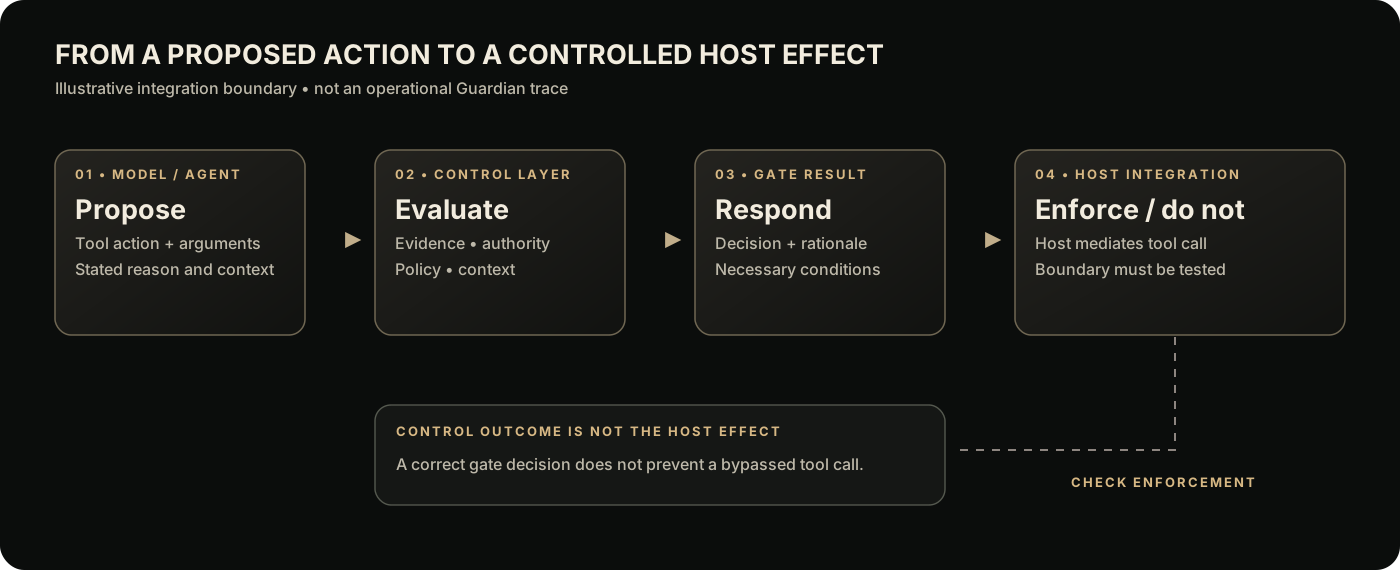
Guardian evaluates a proposed action. The host must enforce the resulting constraint. A positive gate
decision without intercepted host control is not end-to-end control. The Evidence Window above is the
public quantitative record (E3); the diagrams below are conceptual, not live replay.
Maturity: Technical preview — not production certification.
Credible deliverables in a scoped evaluation (only if terms are agreed):
a bounded review note, a test plan, and access to the published E3 ledger — not customer results,
SLAs, or platform certifications.
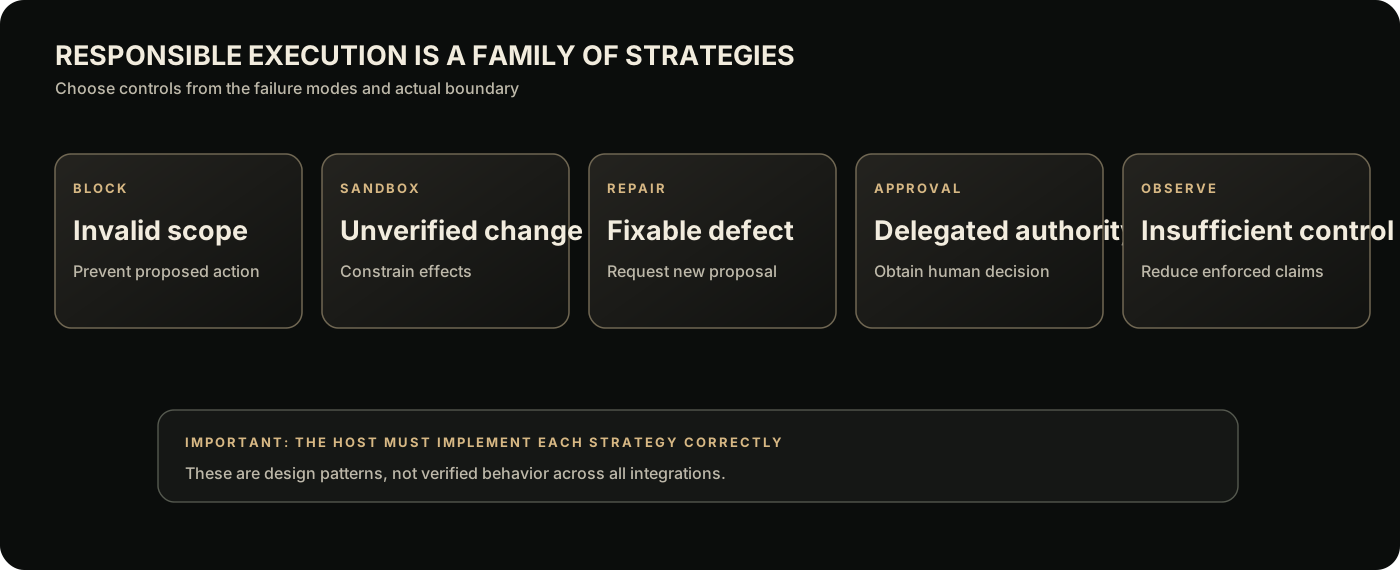
Guardian evaluates proposed actions; actual enforcement depends on the integrated host and its controls.Instrument-mode strategies: block, sandbox, repair, approval, observe. Host systems must implement enforcement. Explore Guardian Runtime
Competitive discipline
Platforms increasingly govern agents as entities. LUXION is developing runtime intelligence for governing stateful transitions from intent to consequence.
Positioning hypothesis — not exclusive ownership of agent-governance whitespace. Guardian remains the current technical preview for that transition.
Policy-to-Execution Layer
Turns governance rules, decision rights, compliance duties, escalation policies, and evidence requirements into runtime admissibility checks.
Policies, risk posture, decision rights, escalation paths, and accountability requirements only matter if they are enforced where AI systems propose action. The Policy-to-Execution Layer translates institutional governance into pre-execution admissibility decisions — not post-hoc policy summaries.
AI governance defines policies, ownership, risk posture, and decision rights. Runtime Stewardship enforces those expectations where AI systems propose action.
Guardian supports Runtime Stewardship by producing structured decisions before execution: action, context, evidence, constraints, route, human-review requirement, and audit trace.
Governance concern mapping
Governance concern
Guardian technical surface
Risk oversight
action risk signals and escalation thresholds
Decision rights
policy-boundary and authority checks
Semantic grounding
context and evidence requirements before action
Human oversight
routed review for uncertain or high-risk actions
Auditability
replayable governed action records
Corrective action
incident review and control updates
Framework and governance language is used for orientation only. Guardian does not replace legal, compliance, security, or sector-specific review.
Audit & Evidence Layer
Creates replayable records of proposed actions, evidence state, constraints, routes, decisions, escalations, and outcomes.
Records proposed actions, decisions, reasons, routes, and replay context for review. Guardian Runtime turns proposed AI actions into governed execution records: action, state, evidence, constraints, decision, route, and audit trace — suitable for replay and institutional explainability.
Audit records support review and accountability. They do not constitute production certification, regulatory approval, or guaranteed compliance.
Compute Governance Layer
Routes evaluation and execution by risk, cost, latency, scrutiny, consequence, and operational context.
Routes actions and evaluations across execution paths based on risk, cost, latency, and required scrutiny — operational routing discipline, not uniform model spend. Measures token usage, route distribution, cost per governed decision, escalation rate, and audit completeness where telemetry is available.
Compute routing is an operational control surface. It does not guarantee optimal cost, latency, or outcome.
Execution Intelligence Layer
Learns where agents fail, where evidence is missing, where controls trigger, and where governance should improve.
Execution intelligence is the compounding data layer generated at runtime — structured records of proposed actions, constraints, violations, decisions, interventions, routes, audit evidence, and outcomes.
Over time, execution intelligence surfaces where agents fail, where evidence is insufficient, where controls trigger, and where governance posture should improve — without claiming elimination of AI risk.
Sector Nodes
Domain runtime packages for sector-specific execution contexts, including cybersecurity, legal/compliance, finance, healthcare infrastructure, manufacturing, aerospace/defense, energy, public sector, and emerging Robotics / Physical AI.
Domain runtime packages for sector-specific execution contexts — explored under controlled deployment pathways, not sector-certified production deployments.
Enterprise AI
Cybersecurity
Finance / operations
Healthcare infrastructure
Manufacturing / industrial automation
Electric grids / energy infrastructure
Aerospace / autonomous systems
Public-sector / institutional AI
Robotics / Physical AI (emerging)
Robotics / Physical AI Emerging
From AI action to embodied action.
As AI moves from digital workflows into physical systems, execution risk becomes embodied. A proposed action may no longer only affect data, tools, or documents; it may affect movement, proximity, manipulation, safety zones, machines, facilities, and people. LUXION extends its execution-control thesis toward embodied systems: should this proposed robotic action be allowed to happen now, under this evidence, policy, environment, authority, and safety state?
LUXION does not certify robotic safety, replace functional-safety engineering, or substitute for ISO/IEC compliance processes. It provides an execution-control and evidence layer that may support controlled evaluation, governance, and deployment design.
Sector nodes indicate explored or evaluated applications of LUXION's execution-control infrastructure. They are not sector-certified deployments, regulatory approvals, or production claims. Robotics / Physical AI is positioned as emerging / strategic only.
Evidence and scope
Deployment pathways, claim boundaries, limitations, and evidence review live under Evidence & Scope.