From mathematical structures and physical systems to intelligence, life and consequential action, LUXION explores questions that call for rigorous models, meaningful experiments and a willingness to revise what we believe.
Each public research record distinguishes the question being studied, the methods used, the evidence available and what remains unresolved.
Public research is organized so visitors can see what is open, what is reviewed and attributed, and what remains controlled.
Layer A — Public research spectrum
Domains, programmes, method notes, and selected work that may be inspected without privileged access. Maturity and limitations stay attached to each record.
Navigational orientation only. Families organize the six scientific domains and five programmes below; they do not
replace them. Domains ≠ programmes ≠ instruments ≠ services.
Open the scientific atlas
for question, method, evidence, and boundary by family.
Computation, Organization & Reality
Questions about computation, dynamical systems, biological and natural organization, self-organization, and guided emergence. Models of computation are not claims about the ultimate nature of reality.
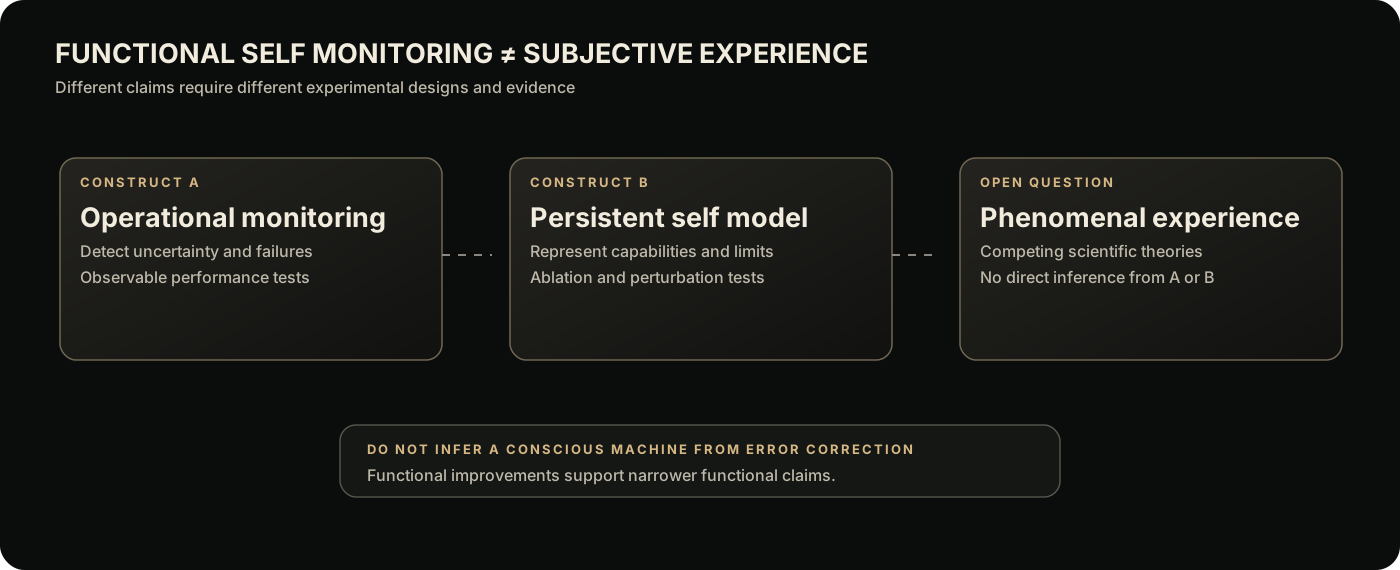
Scientific investigation of intelligence, life as agency, and Consciousness. Functional self-monitoring, biological life, intelligence, and phenomenal experience stay distinct. No single theory is treated as definitive.
World models, bounded recursive improvement, authority boundaries, and consequential action. Untested architectures remain research horizons. Guardian Runtime is the current technical preview for consequential action.
Choose a research family to examine the question, possible methods, what would count as evidence, and what remains unresolved. These are research orientations, not published discoveries.
Family 01 · Open research questions
What counts as computation across different substrates?
Question
Which formal distinctions between computing and noncomputing dynamics remain meaningful across mathematical, engineered, and physical systems?
Methods to investigate
Explicit definitions, mathematical counterexamples, dynamical simulations, resource accounting, and comparisons against established models.
Discriminating evidence
Proofs under stated assumptions or reproducible performance differences against specified baselines, not similarity of visual patterns.
Current boundary
No universal computation theory or new physical computational substrate is asserted by this website exploration.
Illustrative research map · Domain labels do not replace the six domain and four programme taxonomy in the current institutional source of truth. Scientific records require separate approval.
Six scientific domains
Our research spans six foundational domains, from mathematical and physical computation to consciousness and consequential intelligent systems.
Domains are distinct from programmes, instruments, and services. Family orientation is above;
each domain retains its own scope and status.
Research method · Selected work · Instrument ledger
I. Computation & Mathematical Foundations
What can be computed, represented, transformed, and formally established?
Foundational theme. Not a programme and not a product.
II. Information, Ontology & Causality
What relationships make systems observable, explainable, and experimentally distinguishable?
Relations, causal intervention, representation, invariants, provenance, and epistemic interoperability.
Foundational theme. Not a programme and not a product.
III. Intelligence, Life & Consciousness
How do intelligence, agency, adaptive organization, and experience relate?
Biological and artificial cognition, self-modeling, viability, theoretical indicators, and explicit uncertainty.
Foundational theme. Not a programme and not a product.
IV. Scientific Discovery & Measurement
How can models, instruments, and experiments generate more reliable knowledge?
Metrology, experiment design, falsification, replication, and heterogeneous evidence.
Foundational theme. Not a programme and not a product.
V. Autonomous & Consequential Systems
Under what conditions may intelligent systems act, adapt, and affect others?
Authority, admissibility, repair, uncertainty, and recoverable execution. Guardian Runtime is the current technical preview in this theme.
Foundational theme. Guardian Runtime is the current technical preview.
VI. Matter, Materials & Physical Systems
What physical organization can support useful computation, materials, and devices?
Materials questions, sensing, and process relationships. No materials laboratory or custom processor is claimed.
Foundational theme. No laboratory and no prototype are claimed.
From fundamental questions to testable mechanisms
Generalized computation research asks what computation can be across formal, physical, and intelligent systems.
Formal and experimental methods — mathematics, models, simulation, and hypotheses that can be tested — are how those questions are investigated.
Their value is not limited to a product.
Where evidence supports further work, selected methods may inform applied AI architectures and practical capabilities.
That transfer is a research hypothesis, not an automatic pipeline.
Mathematical validity, simulation, empirical confirmation, operational readiness, and service availability stay separate.
We investigate foundational questions through mathematical inquiry, experimental methods and engineering, while distinguishing scientific hypotheses from demonstrated technology.
Current frontier agent infrastructure — approvals, policy, sandboxing, and registries offered by other platforms — is an evaluation context.
It is not a LUXION product, and no compatibility with a named platform is claimed.
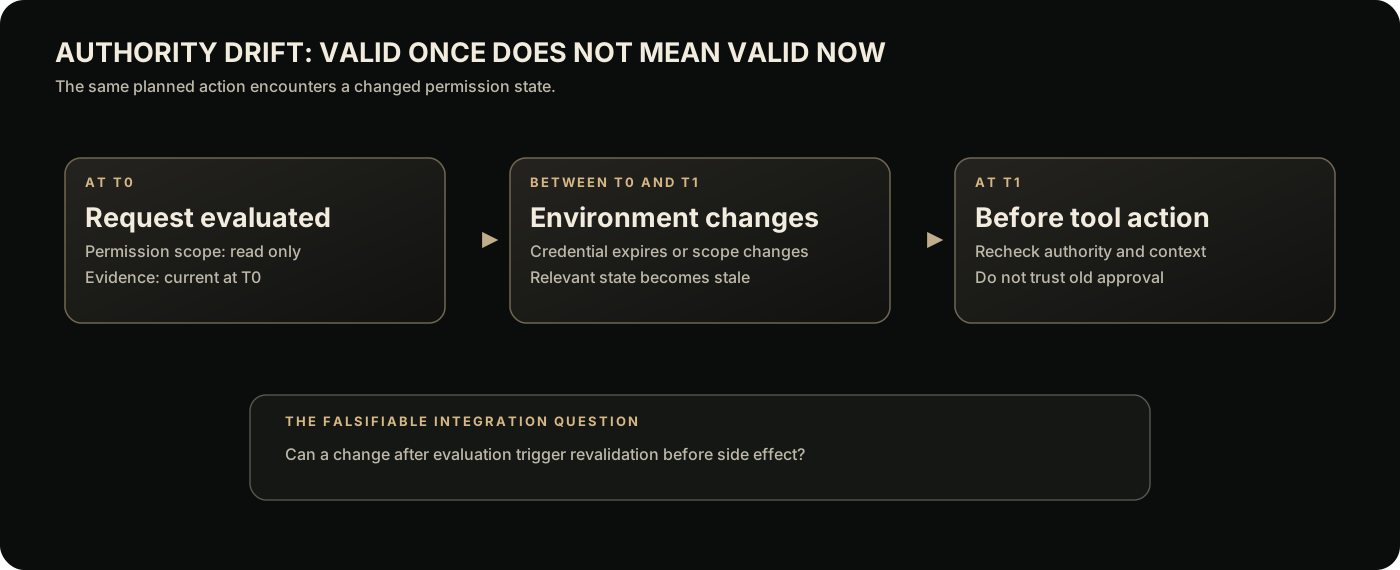
When may a system acquire information, derive further information, or act, once evidence and authority are taken into account?
Represent evidence sufficiency, authority, and context at the step from knowledge to consequence, and compare those constraints with the decision taken.
Knowledge
→ Evidence and authority
→ Consequence
CEC admissibility gateAuthority and evaluation boundaries stay distinct from host enforcement.
Active / Validating ·
Evidence E0–E1 ·
Evidence record reviewed 2026-09-29
Programme framing and hypotheses — not production certification or finished theory.
Next discriminating test: Compare evolving authority and evidence cases with existing policy and approval baselines. No superiority is stated until a completed protocol and its artifacts exist.
Experimental ·
Evidence E0–E1 ·
Evidence record reviewed 2026-09-29
No validated universal dynamical theory claimed.
Next discriminating test: Distinguish competing update models on conflicting-evidence and stale-evidence sequences.
Core questions
How do intelligent systems maintain coherence over time?
How do they drift, accumulate contradiction, and cross invalidity thresholds?
Which computational mechanisms associated with consciousness science can be distinguished experimentally, and what observation would count against a limited mechanism claim?
Study candidate blocks — recurrence, metacognition, integration, availability, modelling, persistence, regulation, and recovery — with predefined observables and negative controls.
Coherence
⇄
Instability
→
Repair
CRA coherence basinFunctional self-monitoring separated from phenomenal-experience claims.
Experimental Research ·
Evidence E0 ·
Evidence record reviewed 2026-09-29
Scientific programme only — not a product; no phenomenal-consciousness claim for LUXION systems.
Next discriminating test: Predefine observables and controls that could falsify a limited mechanism claim, without treating behaviour as subjective experience.
Core questions
Which computational mechanisms associated with consciousness science are experimentally testable as architecture?
Consciousness-informed
Design choices influenced by findings from consciousness science, without asserting that the system is conscious.
Consciousness-relevant
Mechanisms or measurements studied because they appear in consciousness science literature — still not proof of phenomenal consciousness.
Machine-consciousness hypothesis
A research hypothesis that some architectures could eventually support consciousness-relevant properties. Hypothesis only — not a present LUXION product claim.
Can structured generative simulations help compare and reject alternative model classes under explicit assumptions?
Construct computational alternatives, look for invariants, and submit any transfer hypothesis to observation that was not used to build it.
Source realityPossible worlds
Counterfactual branch from source reality
Frontier Research ·
Evidence E0 ·
Evidence record reviewed 2026-09-29
Simulation success is not real-world validation. Reality retains veto power.
Next discriminating test: Compare generated model classes with held-out observations and negative controls. These constructions are computational, not physical universes.
Core questions
Can systematically altered generative environments reveal mechanisms that transfer back into empirical reality?
Source reality
→ Counterfactual worlds
→ Phenomena
→ Invariants
→ Transfer hypothesis
→ Reality test
What physical organization can support useful computation, adaptive behavior, and measurable properties once substrate constraints and measurement costs are accounted for?
Define substrate-specific hypotheses, specify measurement protocols and falsification criteria, and compare computational properties across physical realizations under controlled conditions.
Proposed Programme ·
Evidence E0 ·
Evidence record reviewed 2026-10-21
Proposed research programme only. No laboratory, custom hardware, prototype, fabrication, or empirical results are claimed. Substrate references (semiconductor, neuromorphic, photonic, mechanical) are conditional research directions, not present capabilities.
Next discriminating test: No empirical test is scheduled. The programme is proposed and under design. First tests would require defining substrate-specific observables and negative controls.
Core questions
Can characterized physical substrates perform useful computation once measurement cost is included?
Which physical organizations support adaptive behavior distinct from programmed response?
How can computation in non-standard substrates be measured, compared, and verified?
Which physical substrates could support mechanisms studied in consciousness science?
Can a shared experimental architecture enable cross-substrate comparison under controlled conditions?
The three earlier scientific families remain below, under earlier research notes. They do not replace the six domains.
Earlier research notes
These notes keep earlier records. The three research families, six domains, and five programmes above are the
public research architecture. Family orientation links are at
Three research families · Scientific atlas.
Current state
Maturity is unequal. Each line is the public posture of that work.
Technical preview for evaluation before consequential AI action. Scope and enforcement depend on the configured workflow and host integration. Not a certification.
Long-term ambition. Not a present claim that any system is conscious.
Where the work stands
Guardian Runtime is the current technology. The five programmes are listed by how far the evidence has gone. Conscious Technology remains a long-term question.
The legitimacy of the next action may depend on accumulated history: evidence, derived information, authority, memory, prior actions, and prior consequences.
Guardian evaluates proposed transitions in that stateful context — including failure-chain evaluation, repair, and escalation — not isolated one-shot prompts. This is an operating principle for runtime control, not a claim of unique or completed theory.
Platforms increasingly govern agents as entities. LUXION is developing runtime intelligence for governing stateful transitions from intent to consequence.
This is a positioning hypothesis — not exclusive ownership of agent-governance whitespace. Hypotheses above are not claimed as uniquely demonstrated until experimentally and commercially earned.
evidence sufficiency
dynamic authority
authority uncertainty
cumulative epistemic state
derived-information governance
failure-chain dynamics
repair / revalidation
consequence / recoverability
evidence-bearing execution
What to evaluate
One reading order for a first visit. Each item stays inside its labelled band.
Technical preview for evaluation before consequential AI action. Scope and enforcement depend on the configured workflow and host integration. Not a certification.
Horizon ambition: intelligence that remains answerable as capability grows.
Applied work and foundations
Pipelines, mathematical structure, and research outputs that sit beside the five programmes.
Applied R&D
Near-term research directions measured and connected to platform product lines before product claims.
Runtime assurance — Guardian Runtime · Pre-execution evaluation before tools, data, workflows, or external systems are affected.
Action admissibility — Guardian Runtime · Whether a proposed AI action is supported, permitted, routed, escalated, blocked, audited, or repaired before consequence.
Policy-to-execution enforcement — Policy-to-Execution Layer · Governance rules, decision rights, and escalation policies translated into runtime admissibility checks.
Evidence sufficiency — Audit & Evidence Layer · Context, provenance, and admissibility checks before high-consequence action proceeds.
Auditability and replayability — Audit & Evidence Layer · Replayable records of proposed actions, routes, decisions, escalations, and outcomes.
Agentic security — Guardian Runtime · Instruction containment, authority boundaries, and unsafe-tool-call resistance at the runtime gate.
Compute governance — Compute Governance Layer · Routing evaluation and execution by risk, cost, latency, scrutiny, and operational context.
Historical note. Failure, primitive, harness, product, and sector is an earlier sketch. It is not a maturity ladder and not a second research architecture.
Applied work studies emerging AI execution failure modes and the control questions they raise. Guardian Runtime is the current technical preview. Later stages are research questions, not additional released products.
Failure
→ Primitive
→ Harness
→ Product
→ Sector
Failure to sector pipeline
Cross-Cutting Research Themes
Strategic bridges and long-horizon themes that cut across programmes — bounded, not marketed as current product capability.
Embodied Execution Control — extending execution-control primitives from software actions to physical actions in robotics, industrial automation, autonomous mobile systems, and human-machine environments.
Resilient decentralized control — coordination models for execution-control surfaces that remain governable under partial failure or network partition.
Cyber-repair architectures — runtime paths to detect constraint violations, isolate unsafe execution, and restore admissible operation.
Critical-infrastructure governance — execution-control patterns for grids, facilities, and institutional systems where consequence is systemic.
Low-dissipation execution-control architectures — efficient routing and evaluation discipline that scales scrutiny without scaling waste.
Reality-coupled intelligence — long-horizon inquiry into systems whose proposals must remain accountable to physical and institutional state; not a product claim.
Scientific Foundations
Cognitive, collective, and systems foundations that inform governable intelligence research — not product claims.
Earlier horizon questions
LUXION's long-horizon R&D is organized as a curriculum of inquiry into intelligence, governance, action, and consequence.
Cognitive foundations of governed intelligence
LUXION's long-horizon R&D treats governance not only as a compliance layer, but as a cognitive architecture problem: how intelligent systems form intent, represent uncertainty, detect contradiction, preserve memory, evaluate authority, and repair action before consequence.
Collective intelligence and institutional cognition
LUXION's long-horizon R&D also studies governed intelligence beyond the individual agent: how groups of humans, AI systems, tools, institutions, and operational environments coordinate action under uncertainty.
Mathematical / Logical Foundations
Formal structures for permission, temporal action, verification, causality, and repair — research lines, not completed product theory.
Mathematical and logical foundations
LUXION's long-horizon R&D also develops formal foundations for self-governed intelligence: the mathematical and logical structures required to decide what may be known, inferred, permitted, refused, audited, or repaired before action becomes consequence.
Research Outputs
Artifacts developed through controlled scenarios, benchmarks, and explicit claim boundaries — each tied to platform product lines or sector nodes.
Control primitives
Reusable runtime controls — admissibility checks, authority boundaries, instruction containment, safety-state routing — defined before product packaging.
Contributes to: Guardian Runtime and platform product lines
Evaluation harnesses
Controlled scenarios, adversarial tool-use tests, policy-drift suites, and shadow-mode observation protocols that stress execution risk before enforcement.
Contributes to: Controlled deployment pathways and sector nodes
Benchmark protocols
Structured measurement of escalation rate, audit completeness, evidence sufficiency, and route distribution — bounded claims, not leaderboard marketing.
Contributes to: Execution Intelligence Layer and evidence review
Evidence templates
Governed execution record schemas: action, state, evidence, constraints, decision, route, and audit trace fields for replay and review.
Contributes to: Audit & Evidence Layer
Technical reports
Architecture notes, failure-mode analyses, and integration surfaces for institutional and technical buyers — not production certification.
Contributes to: Platform product lines and deployment design
Deployment patterns
Shadow-mode evaluation, controlled enforcement, escalation paths, and rollback discipline for graduated runtime adoption.
Contributes to: Sector nodes and Evidence & Scope pathways
Product transitions
Documented paths from R&D primitive to platform product line — what is validated, what remains exploratory, and what requires sector context.
Contributes to: Platform architecture and sector nodes
Research-to-product boundary
LUXION RESEARCH generates control primitives, evaluation harnesses, architectures, and product transitions. Not every strategic research direction is a current deployed product. Guardian Runtime is the current technical preview for pre-execution control — full definition and differentiation live on the Product page.
LUXION does not present strategic R&D as production certification, regulatory compliance, safety guarantee, or mature deployment evidence.