Evidence before assurance. Status, limitations, and review dates stay attached to the claim.
LUXION does not ask institutions to trust abstract AI-safety claims. It produces operational evidence surfaces within controlled deployment pathways — with explicit status, evidence level, limitations, and review cadence.
What the Evidence Supports. A claim earns credibility through a clear method, inspectable evidence and explicit limitations.
We distinguish implemented mechanisms, bounded evaluations, active research and open questions.
Records that exist are linked from this page and the evidence log.
Five experimental protocols are proposed and unpublished. They are not results.
Evidence is open to challenge. A correction request should name the public page or record and should not include private data.
How to challenge a finding
Related mechanism diagram (conceptual, not a replacement for the Evidence Window):
Gate versus host enforcement.
Provenance literacy figure. Layer C dossiers remain non-public.
Layered scientific disclosure
Public research is organized so visitors can see what is open, what is reviewed and attributed, and what remains controlled.
What does progress cost, and what does it justify?
Where measurements are available, utility, interventions, latency, computational demand, and relevant resource
costs should be read together. A more efficient workflow is not automatically a safer or more sustainable one.
No energy, emissions, or lifecycle figure is published here, because those measurements are not in the public
record. Conclusions must preserve experimental conditions and uncertainty.
Action → Evidence → Route → Audit → Scope — evidence and scope are bounded at the audit threshold, before operational consequence.
Constitutional evidence layer
Company identity does not grant technical authority to a product or scientific certainty to a programme.
This page remains the claims constitution. A material claim is read against its evidence, maturity, and
stated limits. This page does not add review dates, benchmarks, customers, or certifications.
Every public research or product claim should carry: status, evidence level, limitations, last reviewed, and — where appropriate — the next discriminating test.
Evidence & Scope is the company constitution for claim boundaries. Research programme pages and the evidence log inherit provenance fields (FIRST_PUBLISHED / LAST_REVIEWED / CURRENT_STATUS / EVIDENCE_LEVEL / LIMITATIONS). Absence of a field is information — not implied maturity.
Research maturity / evidence ladder
Every public claim should sit on an explicit rung. Absence of a rung is information. Do not assign a level without evidence.
E0 — Open QuestionOpen inquiry; no empirical claim.
E6 — Deployment EvidenceEvidence from real deployment context.
E7 — Repeated Real-World EvidenceRepeated operational evidence over time.
Current public Guardian harness package maps to E3.
Guardian Pilot public package: AgentDojo-compatible budget validation; official_comparable=false; not production certification. Higher rungs are not claimed.
Reusable claim-bounded cards for the current public posture. Dates on these cards are evidence-log review dates, not a page-level approval and not a website publication date.
Guardian Pilot internal empirical package (E3)
E3ACTIVE empiricsACTIVECurrent
Evidence record reviewed
Public quantitative Guardian claims remain bounded to the AgentDojo-compatible budget validation package on Guardian Pilot.
budget_nonleaderboard; official_comparable=false; not production certification. E4–E7 not claimed.
LUXION produces evidence surfaces around proposed AI actions — within controlled deployment pathways, not through certification or abstract safety promises.
What the agent or workflow intends to execute before commit.
Applied constraints
Policy, risk, and governance limits evaluated against the proposal.
Evidence state
Whether supporting context and provenance are sufficient to proceed.
Authority boundary
Whether decision rights match the proposed action in this context.
Policy route
How institutional policy maps to admissibility at runtime.
Decision
Allow, delay, route, block, or scaffold — recorded before consequence.
Escalation path
Human or institutional review when evidence or authority is insufficient.
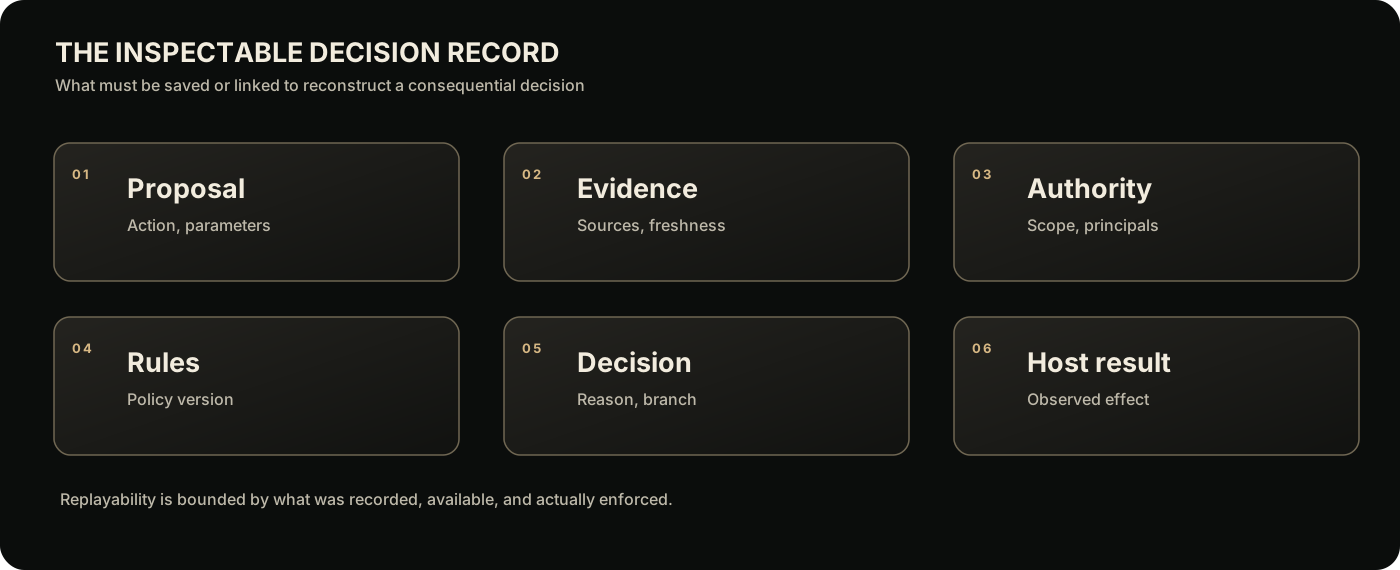
Replayable audit record
Structured trace for incident review, near-miss analysis, and control updates.
Do not claim
LUXION solves, eliminates, certifies, or guarantees AI safety.
Say instead
LUXION creates runtime control surfaces.
LUXION applies admissibility checks before execution.
LUXION produces evidence records and replayable audit traces.
LUXION provides escalation paths for high-consequence proposals.
LUXION supports controlled deployment pathways — not certification.
Controlled deployment pathways
LUXION enters operational use through a deliberate sequence — architecture fit first, observation before enforcement, evidence review before domain expansion.
1
Architecture review
Bounded fit conversation — integration surfaces, action inventory, policy boundaries, evidence maturity, and deployment design.
Record proposed actions, constraints, risk signals, and decisions without interrupting production workflows.
3
Shadow-mode evaluation
Compare runtime decisions against live traffic to establish baseline fit before any enforcement.
4
Controlled enforcement
Graduated allow, block, and escalate with agreed policies, escalation paths, and rollback.
5
Evidence review
Assess false-positive and false-negative patterns, latency impact, audit completeness, and recommended control updates.
6
Domain expansion
Extend governed workflows and sector context as evidence matures — not instant enterprise rollout or certification.
Pathway outputs inform fit assessment and deployment design — they do not constitute production clearance, safety certification, or regulatory approval.
Architecture review deliverables
An architecture review maps where AI-generated intent can become operational consequence — across AI action surfaces, tool calls, data movements, memory writes, workflow effects, authority boundaries, evidence requirements, escalation paths, and sector constraints.
Each review produces structured artifacts shaped around real workflows and institutional constraints — for replay and runtime control, not standalone advisory reports or certification.
What an architecture review maps
AI action surfaces
tool calls
data movements
memory writes
workflow consequences
authority boundaries
evidence requirements
escalation paths
sector constraints
Typical deliverables
Structured outputs from architecture review and shadow-mode scoping — for replay and runtime control, not certification:
Action inventory
Policy-boundary map
Evidence sufficiency checklist
Route-decision model
Human-review path
Governed action record
Technical scoping report
What can be evaluated
During shadow-mode pilots and controlled enforcement, institutions can review observable patterns — not universal prevention or guaranteed mitigation.
Unsupported actions detected
Proposals that lack sufficient evidence or context before execution.
Unsafe tool calls blocked or escalated
Tool-use attempts evaluated at the runtime gate — not claimed as universal attack prevention.
Ambiguous proposals routed
Uncertain actions directed to human or institutional review paths.
Unauthorized data movement surfaced
Data access and memory operations flagged before commit.
Policy drift identified
Gaps between documented policy and runtime admissibility behavior.
Evidence gaps mapped
Where proposals proceed without sufficient provenance or context.
Silent failures made replayable
Near-miss and incomplete-action patterns captured in audit envelopes.
Escalation quality reviewed
Whether routed cases carry structured context for accountable review.
Control-trigger patterns observed
Where constraints, violations, and interventions recur across workflows.
Evaluation surfaces describe what can be observed and reviewed during controlled deployment — not guaranteed detection, elimination of risk, or production certification.
Limitations and non-certification
LUXION does not eliminate AI risk, certify compliance, replace legal, clinical, cybersecurity, financial, or compliance review, or guarantee safe AI behavior. It provides execution-control infrastructure and evidence surfaces for controlled deployment pathways.
LUXION does not certify robotic safety.
LUXION does not replace functional-safety engineering.
LUXION does not substitute for ISO/IEC, legal, medical, financial, cybersecurity, or regulatory compliance processes.
Strategic R&D is not the same as deployed product maturity.
LUXION can support institutional risk, governance, evidence, and accountability workflows — but it does not certify institutional compliance.
It is runtime infrastructure designed to support accountable AI deployment: execution-time decisions, evidence sufficiency, escalation paths, action provenance, and corrective signals where AI systems propose action.
Framework references are used for institutional orientation only. Guardian does not certify legal, regulatory, or standards compliance.
Institutional orientation describes where Guardian can support institutional workflows during bounded evaluation and controlled deployment pathways—not where it replaces counsel, compliance sign-off, or sector-specific approval.
Product evidence bridge
Guardian Runtime is the current technology, a technical preview for evaluation before consequential AI action. Scope and enforcement depend on the configured workflow and host integration. It is not a certification.
Claims remain bounded by evidence tier, benchmark protocol, deployment context, and reproducibility status. AgentDojo-compatible budget validation is an internal and pilot-facing discipline—not an official AgentDojo leaderboard submission and not a substitute for production certification.
Detailed product mechanics, control surfaces, and bounded empirical evidence materials live on guardianpilot.org for product evaluation.