Null and alternative
H0: the measure changes under selected admissible transformations or cannot distinguish cases. H1: within explicit assumptions, invariance and discriminatory power hold under preregistered cases.
Research / Method
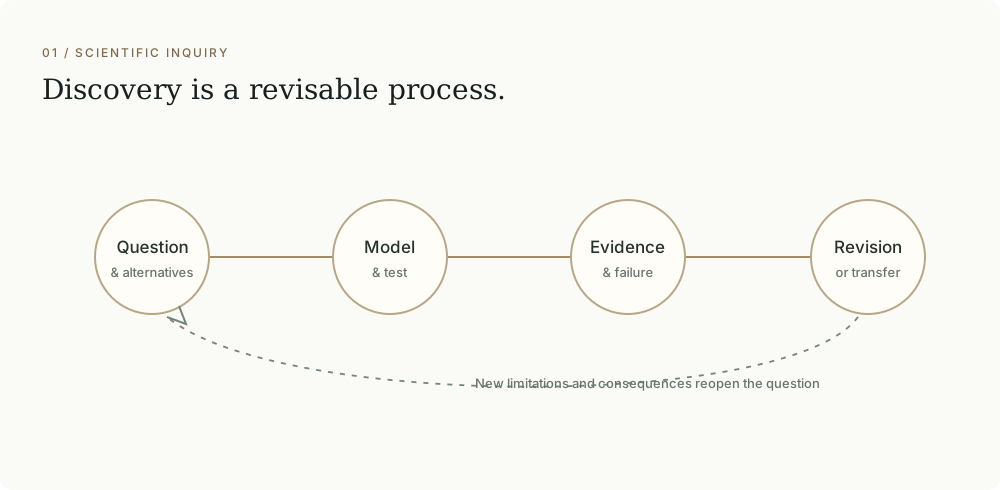
Our research process aims to make interpretations, experiments, limits, counterexamples and negative findings visible.
Specify terms, assumptions, scope, competing hypotheses and meaningful observations.
Use independent baselines, controlled interventions and falsifiable contrasts.
Track counterevidence, uncertainty, defects, provenance and the next test.
A publishable record should include: research question, contributions and authorship, epistemic state, mathematical assumptions, test system, methods and instruments, evidence and source files, baseline comparisons, limitations, negative results, conflicts, and status of external review.
Operational self-monitoring, cognition, agency and phenomenal consciousness are distinct constructs. A result on one does not establish all others. No single mechanism or metric is treated as proof of phenomenal consciousness. Prediction is not causal identification. Evidence is not authorization.
Proposed test, not a completed experiment: can a formal information property be invariant under a class of admissible re-encodings while separating distinct dynamical structures?
H0: the measure changes under selected admissible transformations or cannot distinguish cases. H1: within explicit assumptions, invariance and discriminatory power hold under preregistered cases.
Define transformation group, construct fixed synthetic cases, compare baseline metrics and counterexamples, report sensitivity and compute costs. A single violating transformation rejects the unrestricted invariance hypothesis.